 The state of Florida, a state I myself call home, is home to some of the most beautiful beaches in the United States of America. The state has some 8,436 miles of coastline facing the Atlantic Ocean on the states east coast and facing the Gulf of Mexico. In addition, there are countless lakes, rivers, streams, creeks, and canals.[1]
One of these canals, The Okeechobee Waterway, is unique in that it is the only true navigable cross Florida canal. The waterway itself spans 154 miles, stretching from the Atlantic Ocean near the town of Stuart, FL, to the Gulf of Mexico at Fort Myers, FL. Part canal and part river, the eastern end of the waterway starts in the St. Lucie River, then moves west and passes through the St. Lucie lock and dam, and then it enters Lake Okeechobee through a lock at the town of Port Mayaca, FL. On the other side of the lake, the waterway continues on its journey west, passing the town of Clewiston, FL following the Caloosahatchee River to its mouth at Ft. Myers.[2]
Lake Okeechobee, the St. Lucie River, and the Caloosahatchee River, and the overall Okeechobee Waterway are part of a complex water management system known as the Central and Southern Florida Flood Control Project. Built the United States Army Corps of Engineers (ACOE), and it is jointly managed by them and the South Florida Water Management District (SFWMD). All of this is the direct result of the September 16, 1928 Lake Okeechobee Hurricane. It was a catastrophe that few foreseen and it devastated the communities on the lakes southern shore. Towns like Clewiston and Canal Point, a region which at the time was home to over 6,000 people, were completely wiped away. The early twentieth century structures that populated the area were no match for storms might, nor was the modest muck dike that protected the area from the lakes water.[3]
No one knows for sure how strong the wind was, but estimates are that 125 mph winds lashed out at the area, while relentless rain pelted the area, causing the dikes to breach and a historical flood to sweep across the area. The exact number of casualties remains unknown, but estimates are that around 2,000 people lost their lives, all within about 6 hours, however like a lot of facts surrounding this incident, no one knows for sure. However, one thing that is for sure and the disaster is the third most deadly in U.S. history, and it changes South Florida and the Everglades forever.[4]
In order to make sure this region never suffers a disaster of this magnitude ever again, the ACOE embarked of what was its first major flood control project. An enormous dike was erected to replace the muck one that the storm destroyed. In some areas this new dike, called the Herbert Hoover Dike, is as high as 45 feet in some areas. In building such a gargantuan flood control system, the ACOE has up to this date been able to keep Lake Okeechobee from spilling its waters, but in doing so they, in many ways, changed the Everglades and South Florida forever.[5]No longer would the lakes fresh waters—which at the time was becoming increasingly rich in nitrates and phosphorus due to sugar farming in the area—get filtered naturally south through the Everglades and into Florida Bay. One of the world’s largest estuarine systems and seagrass communities has now become too salty, and the problems don’t stop there.[6]
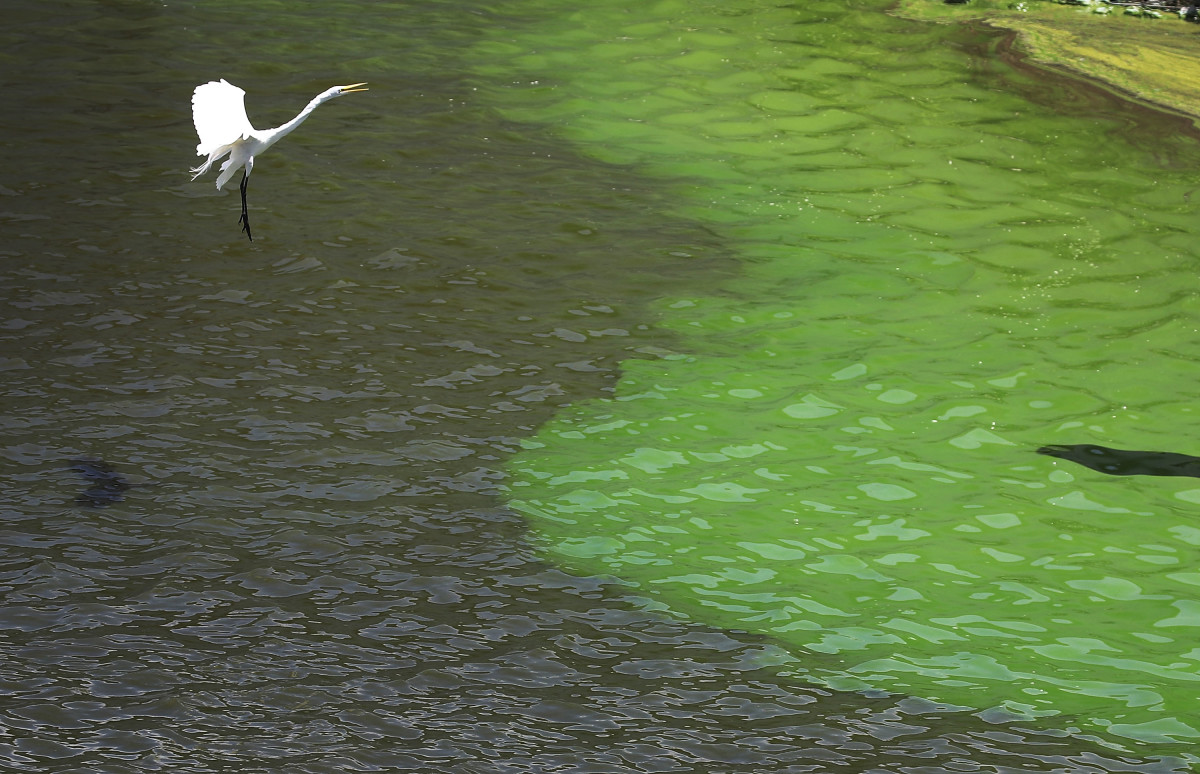
As storms of all forms, shapes, and sizes increasingly become more and more frequent,[7]the ACOE is forced to use the system of locks, dams, canals, and pumping stations to send nutrient rich fresh water through the Okeechobee Waterway into the sensitive estuaries at the mouth of the St. Lucie and Caloosahatchee rivers.[8]The result has been, especially in recent years, increase in massive out-breaks of toxic blue-green algae and red-tides.[9]Collectively referred to as Harmful Algae Blooms (HABs), they cause catastrophic damage ranging from die offs of fish and marine mammals, to negative health impacts on humans, especially those suffering from a preexisting medical condition, and they can be fatal to dogs. Even walking on a beach where a HAB is occurring can be toxic, as fine particles are released into the air when the waves break.[10]
It is ironic that in the interest of protecting another major catastrophe like the Hurricane of 1928, the ACOE along with the SFWMD, have through human error and mismanagement, have created a of a whole different sort. Although HABs have always occurred naturally, industrial farming practices, coupled with sewage run off from private citizens, is causing their size, frequency, and devastation to increase.[11]In order to right the wrongs of the past, many propose that a reservoir is built south of the lake to hold extra water and relieve the pressure on the lake. However, opponents of that plan believe that we will simply wind up with a replicating problem. Instead, perhaps the ACOE should look towards total restoration of the natural flow of water in the Everglades, and properly restore balance to South Florida’s ecosystem.[12]
[1]https://www.florida-backroads-travel.com/okeechobee-waterway.html
[2]https://www.florida-backroads-travel.com/okeechobee-waterway.html
[3]https://www.sun-sentinel.com/sfl-1928-hurricane-story.html
[5]Id.
[6]https://www.washingtonpost.com/news/energy-environment/wp/2016/04/27/this-unprecedented-event-has-now-happened-twice-massive-seagrass-die-off-hits-florida-bay/
[7]https://www.sun-sentinel.com/news/weather/hurricane/fl-ne-climate-rising-seas-hurricane-impact-20190812-3hhp4knwi5gvdgjyji5tihb5sq-story.html
[8]https://calusawaterkeeper.org/issues/lake-okeechobee-discharges/
[9]https://blogs.scientificamerican.com/guest-blog/toxic-algae-blooms-are-on-the-rise/
[10]https://www.noaa.gov/what-is-harmful-algal-bloom
[11]https://phys.org/news/2017-11-farm-runoff-worsening-algae-plague.html
[12]https://www.floridaphoenix.com/2019/08/16/floridas-2-billion-lake-okeechobee-reservoir-plan-wont-clean-water-enough-everglades-expert-says/
Written by Nicolas Grabowski, Associate Editor, EELJ.
 Barry Law Environmental and Earth Law Journal
Leave a comment