While visiting my extended family recently, I had to opportunity to catch up with one of my cousins with whom I had lost contact. As it goes in these situations, we exchanged pleasantries, talked about our families and major life events since our last contact over a decade ago, and discussed our current careers. I was grateful to find that we actually had some similar interests, and this would not become one of those awkward conversations that both parties feel obligated to continue but have nothing left to say. As it turned out, he had become an engineer for the Florida Keys Aqueduct Authority, the water management organization that delivers approximately 16.5 million gallons of fresh water to the Florida Keys each day. As an engineer, part of his responsibilities includes trouble-shooting solutions to challenges that arise. This sparked my interest, since I have been researching the property rights regarding fresh water in the state of Florida and the legal ramifications of the current approach to these rights. It was fascinating to hear the matter-of-fact point of view of an engineer tasked with working within these, sometimes inconvenient, restrictions, while trying to protect the valuable resource of fresh water.
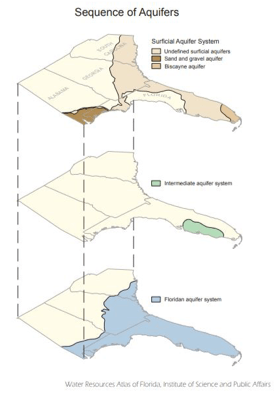
You see, the entire state of Florida sits atop underground aquifers, and is completely reliant on its supply of fresh water. This is especially true in the Florida Keys, where there are no naturally formed lakes. Aquifers can be thought of as an underground system of porous rocks that hold water and allow water to move through the holes within the rock. Fresh and saltwater fill the various sized holes in the rock. Fresh water generally fills the uppermost part of aquifers, while saltwater is present at greater depths due to its higher density. Florida is the only state whose land is one hundred percent above aquifers. It is comprised of three main aquifers: the surficial aquifer, which is broken down into the sand and gravel aquifer and the Biscayne aquifer, the intermediate aquifer, and the huge, statewide Floridan aquifer. Confining layers vary throughout the state. In some areas, the confining layers are absent to very thin, while in other areas, they can be almost 200 feet thick. But no matter how you look at it, they are all connected and interdependent. Yet the regulatory authorities that control the fresh water in Florida are extremely localized. This has created a legal nightmare.
There are two approaches to water property ownership rights in the United States: riparian rights doctrine and public trust doctrine. Riparian rights refer to the approach in which water belongs to the person whose land borders a body of water. Riparian owners are permitted to make reasonable use of this water provided it does not unreasonably interfere with the reasonable use of this water by others with riparian rights. The amount of groundwater right is based on the size of the surface area where each landowner gets a corresponding amount of the available water. This approach originated under the English common law and is prevalent in the eastern United States: especially the original English colonies and early territories and states where property rights have always been precious commodities and surface water is plentiful. The public trust doctrine, also derived from English common law, provides that some resources are so central to the public good that governments can never convey them outright. In central and western states, this approach is more common. Florida’s government originally followed a more riparian rights doctrinal approach. However, a more modern understanding of how interconnected the groundwater aquifer system is and the economic and environmental impacts of its use have led to the evolution of statutes and regulations that lean more towards a public trust doctrinal approach.
Florida’s institution of water management is unique: regional agencies, established by the Legislature and recognized in the state constitution, based on hydrologic boundaries and funded by a tax usually reserved for local government. The 1972 Water Resources Act established five water management districts with broad authority and responsibilities including conservation, allocation, water quality, flood protection and natural systems management. Because water constitutes a public resource benefiting the entire state, it is the policy of the Legislature that the waters in the state be managed on a state and regional basis. So how is it that the local water management districts control the number of permits allowed to private citizens regarding the extraction and use of water drawn from wells on their property?
The language of the WRA is vague at best. It requires that “minimum flow or minimum water levels be established for surface watercourses and aquifers that may be threatened by water withdrawals.” The minimum flow is defined as “the limit at which further withdrawals would be significantly harmful to the water resources or ecology of the area.” The effect is that each water district decides what is acceptable for their region. This is extremely political and reflects the desires of the local population more than scientific data or the commonwealth of the entire state. So, while residents of Ocala, for example, may see the spring levels receding and cast their ballots for representatives who will protect water in their district, residents of Miami may see the need to reduce salinity of the water in Biscayne Bay a priority worth pumping millions of gallons from the Floridan Aquifer. Both have the legal right to restrict or exploit the use of the water, and yet their actions affect each other.
Due to the intertwining of the groundwater resources in Florida through the aquifer system, legislation that addresses the inevitable cross-contamination of local decisions regarding groundwater extraction and preservation must be enacted. Informative campaigns focused on educating the public and highlighting the positive effects of water districts working in a more collaborative nature will increase support for this legislative change that puts the valuable public resource of clean water ahead of local preference or private economic gain.
Written by Tami Dacey Budd, EELJ Associate Editor
Resources
Fernald, E. A., and E. D. Purdum, Water Resources Atlas of Florida 1 (Tallahassee: Institute of Science and Public Affairs, Florida State University, 1998).
Condran Michael, et al., The Future of Water Supply in Florida, Water Online. https://www.wateronline.com/doc/the-future-of-water-supply-in-florida-0001
Florida’s Aquifers, St. John’s River Water Management District. https://www.sjrwmd.com/water-supply/aquifer/.
Marian P. Berndt et al., The Quality of Our Nation’s Waters: Water Quality in the Upper Floridan Aquifer and Overlying Surficial Aquifers, Southeastern United States, 1993–2010, U.S. Geological Surv. https://pubs.usgs.gov/circ/1355/.
Miller, James A., Ground water atlas of the United States, Segment 6, Alabama, Florida, Georgia, and South Carolina1 (1990). https://pubs.usgs.gov/ha/730g/report.pdf
 Barry Law Environmental and Earth Law Journal
Leave a comment