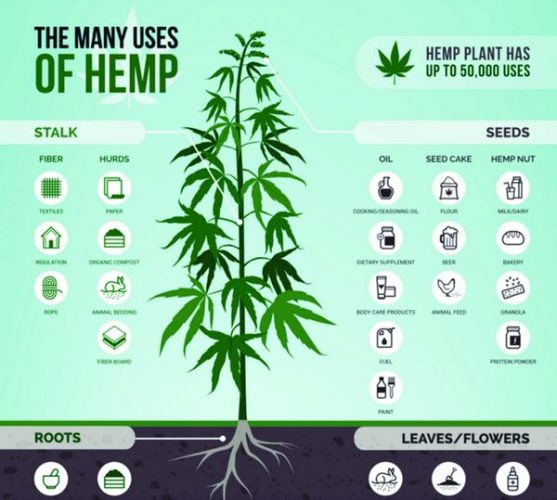
Hemp, the sober cousin of marijuana, is known to be the one of the most versatile plants in the world. It has been cultivated for more than 10,000 years and is said to have over 25,000 uses. Hemp was so popular that it was mandated for farmers to grow hemp seed during the colonial years.
Fiber from hemp plants are used to make many textile and industrial goods. The end-uses and application of hemp has evolved over time ranging from sail clothes, wine, clothes, paper, building material to therapeutic and medical purposes. Hemp was widely used until Congress passed the Controlled Substance Act in 1971, which classified hemp as a Controlled I substance and made hemp illegal.[1]
Recently, the 2018 Farm Bill was signed into law which legalized the production of hemp and removed its controlled I substance designation.[2] There has been a rejuvenation of hemp as more people are interested in eco-friendlier products.
Hemp is different from other plants because hemp has sustainable natural characteristics. It does not need much water to grow and its carbon footprint is minimal. Hemp absorbs carbon dioxide making the air cleaner and easier to breathe. Hemp improves the soil because it returns many nutrients back into the ground. Hemp plant is naturally resistant to pests so it does not need any pesticide application.
Why should we start using hemp-derived products?
The environmental impact that has been caused by human activities has led to serious concerns on the depletion of our natural resources. Plastic waste is infinite and everywhere killing aquatic and wildlife, air pollution is apparent in parts of the world, and nondegradable waste ends up in landfills leading to soil pollution. It is estimated that the population will reach 9.7 billion by the year 2050.[3] The rate in which we are consuming our natural resources is not sustainable. We must change human practices to be more sustainable if we want to be able to support and protect future generations. It is time to go back to the roots of America and make the switch to hemp products.
Hemp provides alternatives and can replace many commodities we use today. There has been a rejuvenation of hemp as it is being more socially acceptable. Many different type of paper can be made from hemp. At the same time, using hemp as paper will help decrease deforestation. Hemp plastics are returning and have seen a rise in demand. Hemp plastics decompose, its biodegradable, and recyclable. Hemp is stronger and durable than cotton. It makes for a better fabric for clothing because it gets more comfortable after multiple uses and washes. Although the benefits of hemp, hemp products are not cheap because of the manufacturing process it entails. Even though the hemp industry is still in its infancy stages, hemp’s newly legal status will allow opportunities for new markets to develop and promote the growth and use of industrial hemp. I think as hemp production becomes more cost effective it will eventually phase out many industries that are not “green” or eco-friendly. Hemp presents many qualities that is beneficial to the world, humans, plants, and animals. It is now time to make the switch to hemp-derived
[[1]]https://fas.org/sgp/crs/misc/R45948.pdf
[[3]] https://www.un.org/development/desa/en/news/population/world-population-prospects-2019.html
Written by Michael Lavin, EELJ Associate Editor
 Barry Law Environmental and Earth Law Journal
Leave a comment