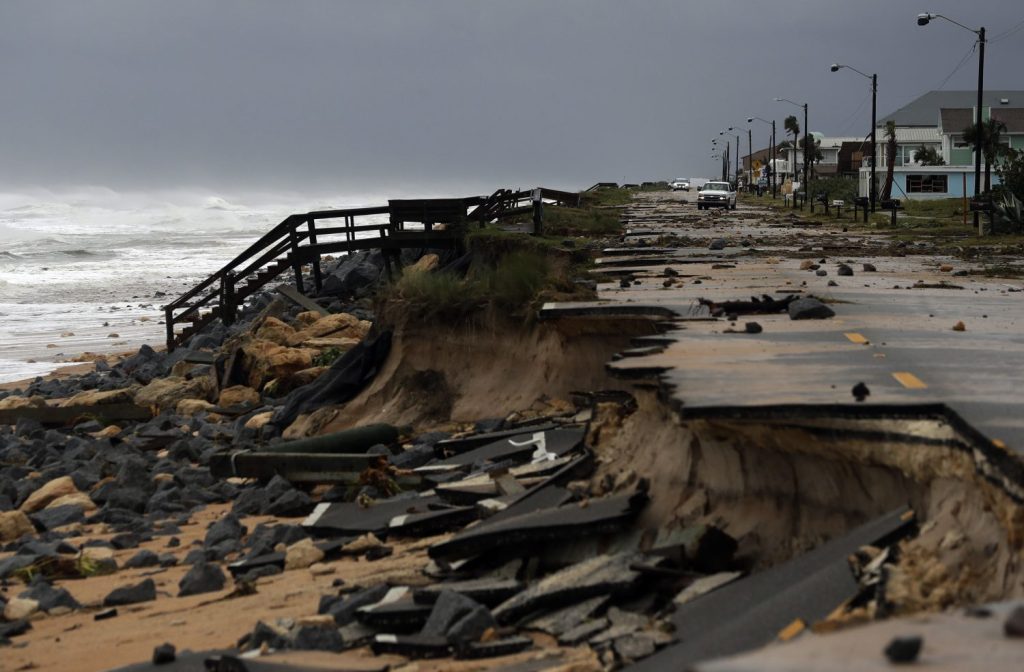
Sea-level rise is just one of the numerous effects human-induced climate change has brought upon the planet, with average sea levels having swelled over eight inches since 1880, and about three of those inches gained in the last twenty-five years. [1] Although the current rise in sea levels may seem miniscule, the potential effect this poses to coastal habitats and communities alike may prove to be quite disastrous in the near future. Scientists are conducting ongoing research in an effort to determine how much and how soon levels will rise, but most predictions reveal that the warming of the planet will continue and is likely to accelerate, causing the oceans to keep rising, meaning that hundreds of coastal cities face flooding. [2] Already, flooding in low-lying coastal areas such as barrier islands is forcing people to migrate to higher ground, and millions more are vulnerable from flood risk and other climate change effects. [3] One of these effects is destructive erosion, specifically beach dune erosion.
A principal benefit for anyone living near a shoreline is that the beach dunes act as a storage reservoir for sand that is made available during infrequent but severe storms. [4] The larger the dune, the more time it takes for it to be eroded by the waves, and the more protection it provides to areas further inward. [5] Thus, beach dunes protect the landmasses they border and serve as a buffer against storm surge, extreme tides, and wave effects. [6] Climate change and the accompanying rise in sea level pose an entirely new threat to beach dunes and erosion, especially when taken into consideration with the increasing amount and strength of natural disaster such as hurricanes that are imposed by a warming of the planet. [7]
Although the fluctuations between erosion and recovery that beach dunes frequently endure is a natural process, more often than not the erosion from powerful storms such as hurricanes leave the dunes in specific areas around the world in a state of devastation beyond the possibility of natural recovery. [8] In such circumstances, human intervention and adaptation measures must be taken to assist the beach dunes and the surrounding natural environment in order to return the natural order of the area and protect against future storm-induced erosion. This guided assistance typically consists of a beach dune restoration project of some sort, which needs to be carefully designed and planned in order to fit with the natural features of the specific area in which it is being implemented. [9] This is due to the fact that almost every coastal ecosystem is different, with specific species of plants and animals that inhabit the area and play an important role in keeping the ecosystem afloat and thriving. [10]
My hometown of Flagler Beach, Florida is a barrier island positioned between St. Augustine and Daytona Beach, where an ongoing clash is taking place between beachfront property owners who own small parcels of land that include a piece of the beach dunes directly across from their oceanside homes, and the governmental agencies who have provided about $25 million in federal and state funding to enact a beach dune restoration project following the damage inflicted by Hurricane Matthew. [11] There is a small group of said property owners refusing to sign easements allowing the federal, state, and local agencies involved to move forward with the beach dune restoration project. [12] Those refusing to sign the easements are doing so in fear that they will lose their access and rights to the miniscule parcels of the beach dunes that they own. [13] The main governmental agency involved, the U.S. Army Corps of Engineers, has extended the deadline to acquire the signed easements, stating that they will not move forward with the project until all necessary easements are signed because it would essentially cause a hole or breach point in the line of restored beach dunes that will be the focal point of flooding if another hurricane were to batter the coastline. [14]
Not only were the dunes along Flagler Beach’s coastline eroded severely by Hurricane Matthew, the storm also washed away 1.3 miles of scenic State Road A1A positioned directly behind/above the dunes. [15] The proposed restoration project will not only repair the aftermath of Hurricane Matthew, but will also save the county from future storm damage when another hurricane passes through. [16] In an effort to secure the few remaining signed easements, Flagler Beach resident Carla Cline has set up a GoFundMe page with the goal to raise $40,000 in hopes of paying off the remaining holdouts. [17] The page currently has raised close to $60,000. [18] Local officials are opting to preserve eminent domain proceedings as a last resort option if the property owners continue to refuse to the sign easements, but will not hesitate to procced if deemed necessary. [19]
One thing is for certain: sea levels will continue to rise due to human-induced climate change, likely bringing more hurricanes of greater strength, and the town of Flagler Beach along with other barrier islands along the coast of the United States will have to adapt to these inevitable changes. Beach dune restoration projects are often the first step in planning accordingly for the future of barrier island communities, and without their enactment the future could be devastating beyond what past storms have inflicted.
Written by Charlie Gray, EELJ Associate Editor
 Barry Law Environmental and Earth Law Journal
Leave a comment