Recently, on January 27, 2021, President Biden took executive action to revitalize energy initiatives in communities that have been adversely impacted by brownfield sites. [1] Through the recent executive order, President Biden created an Interagency Working Group on Coal and Power Plant Communities and Economic Revitalization. [2] The recently developed Interagency Working Group is co-chaired by the National Climate Advisor and the Director of Nation Economic Council. [3] Specifically, the executive order directs the Interagency Working Group to turn idled properties in communities adversely impacted by brownfields into “hubs for the growth of our economy.” [4]
Brownfields are defined by the Environmental Protection Agency (EPA) as “a property, the expansion, redevelopment, or reuse of which may be complicated by the presence or potential presence of a hazardous substance, pollutant, or contaminant.” [5] These properties are typically closed landfills, scrap yards, mines, and other sites that are similarly contaminated. [6] In the United States, there are more than 450,000 brownfield sites, which includes roughly 80,000 sites pre-screened for renewable energy use. [7] [8]
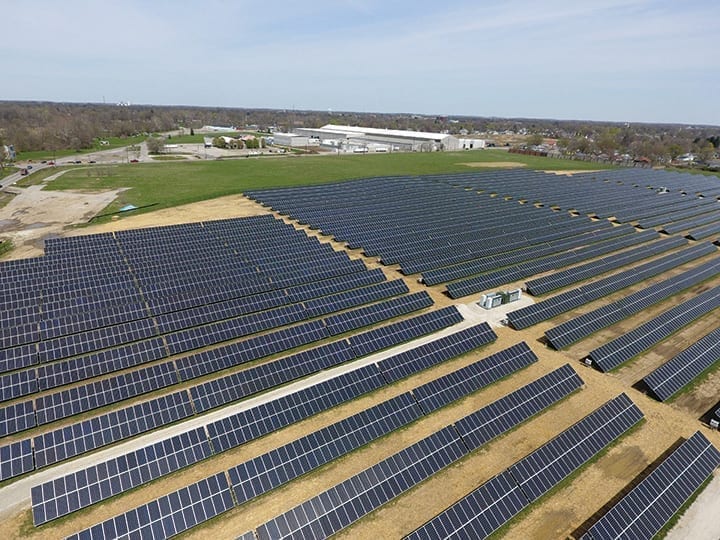
However, a major issue is that most of these sites remain vacant and unused. [9] For instance, there are over 10,000 closed landfills that sit vacant and unused, which totals more than fifteen million acres. [10] These contaminated lands could provide attractive opportunities to redevelop contaminated sites with renewable energy infrastructure, such as solar farms. [11] This concept is referred to as “brightfields.” [12]
Brightfield developments could provide several environmental benefits by converting to solar energy over the traditional use of fossil fuels. [13] Greenhouse gas emissions and discharging other particles into the air adversely impact our environment. [14] Whereas converting to solar energy would be an ecofriendly infrastructure transition since it is a zero-emissions process. [15] Additional positive aspects of converting to solar energy include combating climate change, improved public health, inexhaustible energy, jobs and economic growth, stable energy prices, and a reliable and stable source of energy. [16]
Despite the environmental positives of solar energy, constructing and operating brightfields is complicated by several variables. [17] Solar companies need to consider siting issues, remediation of contaminated sites, and permitting through the EPA or local environmental agencies. Siting issues are caused by the historical issues pertaining to developing on the land. [18] Additional siting issues include the type of land itself, whereby steep slopes and impenetrable surface hinder development efforts. [19] Moreover, redevelopers of brightfields projects near to be weary of CERCLA’s strict liability requirements in which landowners could be responsible for costly remediation efforts on contaminated land. [20] Also, the complex permitting system between EPA and local environmental agencies creates challenges for brightfields. [21] In turn, environmental outcomes vary city to city due to the inconsistent regulation of brightfields. [22]
In overcoming these some of these challenges to a brightfields project, President Biden’s executive order could lead to more brownfield regulatory incentives as a means to promote equitable distribution of economic benefits to communities with minority and low-income residents. [23] It also could lead to EPA reevaluating and reconstructing the current environmental enforcement standards and regulations pertaining to cleanup efforts situated in minority and low-income communities. [24] Another regulatory tool to assist brightfields developers in planning for siting evaluation of a potential brightfields project is the planned redevelopment of EPA’s EJSCREEN tool, which is a publicly available database used to show disadvantaged communities located in proximity to permitted sources of pollution. [25] This tool also shows existing nearby infrastructure that could help with a solar company’s site evaluation. [26]

Written by EELJ Associate Editor, Taylor Morrow
 Barry Law Environmental and Earth Law Journal
Leave a comment