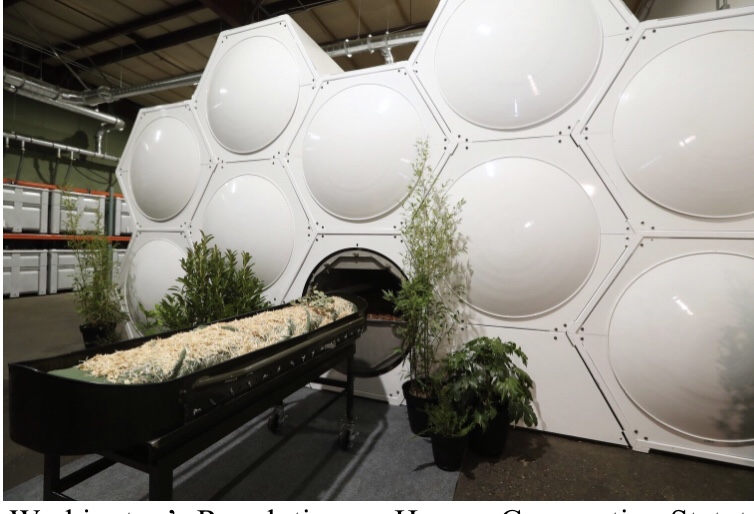
Confronting our own mortality can be challenging, but there is no shaking the truth that we will all die someday. As depressing as that is, the sooner we accept that fact, the sooner we can begin to plan for what we want to happen to the physical body we leave behind and share that plan with loved ones. The American funeral or “death care” industry has typically offered only two choices for what can be done with human remains: the traditional cemetery burial and flame-based cremation. [1] However, with recent advances in technology and public concerns about the environmental effects of the traditional methods, new options have begun to present themselves. From green burials to water-based cremations, few of these new methods have the potential to be as game-changing as human composting.
Human composting is a somewhat self-explanatory term that describes the process of the natural organic reduction of a deceased human body. [2] It works just like composting kitchen scraps, only on a larger scale. A body is placed into a cylindrical container and lightly covered with other organic material like straw and woodchips. [3] The temperature, moisture, and oxygen levels of the container are monitored and controlled, and over the course of a few weeks, the body will break down completely and become soil. [4] Any inorganic materials like replacement joints and dental fillings are removed from the soil during the lengthy decomposition process. [5] The soil is then heated to kill any harmful bacteria or pathogens, then it’s ready for use just like regular soil. [6]
While this method of final disposition may seem strange to some, its environmental benefits are undeniable. Traditional burials require the placement of several tons of steel, concrete, and hazardous embalming fluid into the earth every year, while a year’s worth of cremations is responsible for the creation of approximately 360,000 metric tons of carbon dioxide emissions. [7] [8] According to Recompose, a Washington based human composting provider who helped pioneer the method, for every person that chooses human composting over a more traditional method of burial, one metric ton of carbon dioxide is prevented from entering the atmosphere. [9] Additionally, human composting uses only one-eighth of the energy required by cremation or traditional burial. [10] Further, just like regular composting, human composting creates nutrient rich soil that can help plant life thrive and absorb carbon. [11]
Washington became the first and only state thus far to legalize human composting in 2019, although the service wasn’t offered commercially until 2020. [12] Senate Bill 5001 amended the state’s cemeteries and human remains statute to define “natural organic reduction” and “alkaline hydrolysis,” more commonly known as “aquamation,” and allow both as methods of final disposition. [13] This comes after years of research and work from the founder of Recompose, Katrina Spade. Spade first explored the possibility of human composting in 2013 and founded non-profit the Urban Death Project soon after. [14] Ultimately, Spade helped legalize the method in Washington. [15] This is a big deal because more often than not, innovators like Spade are shut out of legislative processes regarding the legalization of alternative methods of final disposition by those interested in keeping the multibillion-dollar death care industry functioning the way it always has. [16] The importance of developing new, eco-friendly death care options becomes more apparent as urban cemeteries run out of usable burial space, pandemic death tolls strain the resources of existing funeral homes, and the effects of climate change worsen. Washington’s revised human remains statute and the opening of two additional human composting services in the state show that it pays to listen to those innovators pushing for change in death care. [17]
The future of human composting looks bright, with bills being proposed and considered in states like Colorado, Delaware, and Oregon. [18] [19] [20] While the Covid-19 pandemic has caused these bills to be delayed and there are some religious objections to the method, public opinion about human composting seems to be mostly positive or at least neutral. [21] Regardless of whether human composting is the new, green way forward in death care or not, Washington’s legalization of the method will make the state a laboratory for interested parties to closely examine the method for years to come.
Written by Jacob Steele, EELJ Associate Editor
 Barry Law Environmental and Earth Law Journal
Leave a comment