As the United States says so long to Afghanistan and the Taliban rises to power, the world has been left confused and wondering what the future holds for this country. A major battle Afghanistan will have to continue to fight is climate change. Afghanistan is currently the sixth most affected country by global warming, and its effects have been devastating to farmers. [1] Flooding alone causes severe and catastrophic damage, for example in August of 2020 over 150 people died as a result. [2] The country has seen over 400,000 individuals become displaced or made climate change refugees. [3] The severe flooding is a result of melting glacier ice in the Hindu Kush Mountains. [4] The severe temperature rise throughout the country of 1.8 C, and a record high of 2.4C in the south of the country, has caused an almost 14% total area lose of glaciers between 1990 and 2015. [5] While flooding presents a real issue, the country also suffers from severe drought, including a 5-year consecutive drought from 2000 to 2004. [6] The drought mostly impacts rural farmers, however, currently drought is threatening more than 7 million people. [7] This year’s harvest is expected to be “20 percent below the 2020 harvest and 15 percent below average due to acute drought,” according to the Food and Agriculture Organization of the UN.
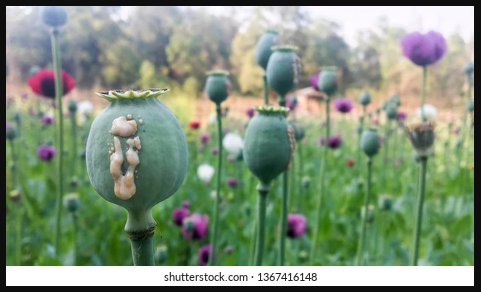
This issue is one that Afghans have been facing for the last three decades. As a result, many of the farmers have adapted and traded out their wheat harvest for poppies. The sap, or opium, that is harvested from the poppy is cultivated and used to create drugs such as heroin. [8] Poppies are extremely resistant to the droughts that plague Afghanistan. [9] Afghani farmers will use the entire poppy plant for its oil and seeds, however, the most controversial part of the plant is the paste collected and used to create 80% of the world’s opium and heroin. [10] The Taliban was quick to profit off this market: smuggling the drugs, taxing them, and facilitating opium extraction. [11] It is estimated the Taliban earned “more than $400 million between 2018 and 2019 from the drug trade.” [12] This revenue is estimated to have supplemented almost 60% of the Taliban’s annual revenue—these percentages come from the United Nations however they have been contested. [13]
Many farmers face a moral conundrum growing poppies. Most of the Afghan farmers are Muslims, which creates some religious tension in the decision to feed their families or avoid growing such a destructive plant. However, this only further emphasizes the fact that most of the individuals who grow poppies would not have resorted to doing so had they any other choice. With recent numbers coming from UNODC Research we find the price of opium is falling by almost 33% in 2018. [14] On top of the decrease, many farmers have been paying a tax to the Taliban at almost 6% for their crop. [15] In the south of the country, we know that almost 3 out 4 farmers are cultivating opium as their main crop. [16] With so many dependent on this cultivation, it is upsetting that very few are capable of investing their income in education or property, as a way to one day be able to move past farming poppies. [17]
Following the Taliban’s return to power in September 2021, they have announced the new government will be known as the Islamic Emirate of Afghanistan and is expected to be run by religious leaders.[18] The Taliban has recently announced a ban on the growing and trade of opium, claiming the drugs were affecting young people in their country, and is now requesting more international aid to help bring opium cultivation to zero. [19] With this new ban on opium cultivation, many of the country’s farmers will be left with a decision to cease growing a crop that provides almost 50% of the family’s income in most regions or to go against the Taliban’s rules. [20] We know from recent news reporting how dangerous it can be to go up against the Taliban. [21]
Without the proper skills to move into a new area of work, and the devastation COVID-19 has caused on lower-income individuals, there are not many options for poppy farmers, outside the cultivation of this plant. The international community has attempted to help Afghanistan with this issue by giving aid. The United States alone has contributed over $8 trillion in the last 20 years. [22] In total the international community has given so much aid to Afghanistan that the World Bank reports about 40% of the country’s GDP is from foreign aid. [23] Despite the little effect this has appeared to make since the Taliban took control, all of the foreign reserves have been frozen. [24] This freeze also includes an additional 4% of its GDP in remittances from family members outside of Afghanistan attempting to send money home. [25]Without aid, without remittances, and with a new ban on poppy cultivation, only time will tell what will become of the Afghani people and their home.

Written by Taylor Carroll, EELJ Associate Editor
 Barry Law Environmental and Earth Law Journal
Leave a comment