
What is timber? Is it just wood? Is it only what a lumberjack says when she sends a tree tumbling down? [1] Or maybe it is also one of the most energy efficient materials we can use when building a home! [2] According to New Energy Works, a company that specializes in design, builds, and framing involving timber, “[A] timber home…[is] like throwing a blanket over a fine piece of furniture. The furniture, much like the timber frame, is nice and cozy under that blanket.” [3] In truth, timber is likely our most famous renewable resource. [4] As a natural product it has few, if any, toxins, and it is biodegradable as well. [5]
So, while it is clearly of benefit to people, the planet, and profits within the real estate realm, there is also a core cultural connection that has been carried over generations across the world. Historically, as a tree begins to die and decay, the stored carbon that has built up in its layers over years, often centuries, releases, and in turn contributes to CO2 emissions. [6] What’s beautiful about this natural process of life is the ability for humans, and other animals too, to use this natural resource as a timber frame for a home, thus acting as a long-term carbon storage mechanism (so long as it is kept dry). [7] Timber frames have been the best use of old trees, large or small, and long-standing woodwork homes have utilized this method throughout the same centuries that these trees are living their lives. [8]
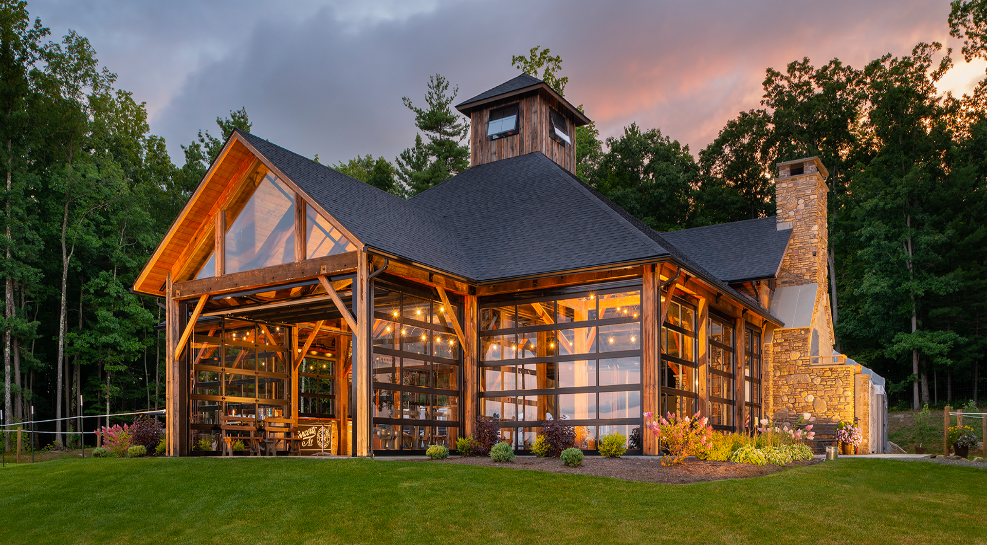
It is important to note that timber framing does have an environmental impact, despite how minimal it may be, because no building technology or resource exists in a vacuum. However, timber is considered to be extremely sustainable and the most renewable, and accessible, resource over long-term periods. [9] Building ‘green’ presents the opportunity to reduce CO2 emissions because buildings are recognized to be responsible for at least 40% of all annual global CO2 emissions. [10] Building ‘green’ may be defined as establishing a “structure that’s environmentally responsible and resource-efficient throughout a building’s life cycle, from design, construction, operation, [to] maintenance, renovation – even demolition.” [11] It is reasoned that one timber frame is equivalent to preventing four tons of CO2 from being emitted when compared to a masonry house. [12]
What is most troubling is the legality of sourced wood. Unregulated, illegal logging has affected scores of ecosystems and by result impacts the Earth in a disproportionate manner. [13] It is estimated that half of the timber that is logged in the world has been harvested illegally. [14] Leadership in Energy and Environmental Design, also known as LEED, is an internationally recognized building ‘green’ certification program established by the United States Green Building Council. [15] To combat the illegal logging issue, LEED has established a Timber Traceability credit that utilizes lab testing for the purposes of matching species of timber in work product with permitted, lawfully logged trees that should have been delivered to the worksite. [16] The largest issue with this strategy is its complication. There are limitations on how far back some wood may be traced, not in regard to genealogy, but specific location. [17] At the same time, money laundering is one of the most advantageous aspects of the illegal timber industry, and considering the possible levels of profitability, it is a reasonable worry that this solution will hardly deter the practice. [18]
Deforestation is defined as “the clearing or severe thinning of a forest or other wooded area, leaving few or no trees.” [19] When illegal deforestation occurs, it often results in the destruction of habitats upon which indigenous communities depend, thereby threatening their livelihoods. [20] A stark example are the actions taken by President Bolsonaro of Brazil, who has weakened dozens of environmental protections of the Amazon and encouraged land development by private entities, warranting affected indigenous people to demand investigation into the matter by the International Crime Court for what they regard as “crimes against humanity.” [21] Interpretation of Bolsonaro’s actions have coined the term ‘ecocide.’ [22] In short, timber is a beautiful means to slow climate change, appreciate cultural history, and to have an elegant, longstanding building such as home, but it is important to also verify that our resources come from a place of equity, equality, and legality.
Written by Jacorry Lewis, EELJ Associate Editor
 Barry Law Environmental and Earth Law Journal
Leave a comment