In 1970 legislatures passed The Clean Air Act (CAA); a federal law targeted towards regulating air emissions from different forms of hazardous pollutants. [1] The act would allow The United States Environmental Protection Agency (EPA) the power to establish National Ambient Air Quality Standards (NAAQS). [2] The purpose of the act was to force each state to identify major sources of air pollutants and address the public welfare concerns on the effects of those threatening pollutants on its population. [3]
National Aeronautics and Space Administration (NASA) has continuously conducted studies to create practical solutions and increase the understanding of air pollutants in accordance with The Clean Air Act. In 1989, NASA conducted a studied titled, “Interior Landscape Plants for Indoor Air Pollutants.” [4] In this study all parts of plants and microorganisms associated with plants were studied to identify their potentials in reducing the air pollutants within enclosed buildings. [5] Additionally, the study aimed at identifying if plants serve as an active indoor filter to remove cigarette smoke, organic solvents, and radon. [6]
Benzene was the first solvent tested. Benzene is commonly manufacture different detergents, dyes, and pharmaceuticals. [7] It is also frequently found in gas, oils, rubber, ink, and plastics. The next solvent tested was Trichloroethylene. This solvent is generally produced in large amounts by metal degreasing and dry-cleaning industries but can be found in varnishes and printing inks. [8] Formaldehyde was the third solvent tested. This solvent can be found in many household cleaning products. [9] Formaldehyde is also found in plastic bags and different forms of tissues and papers. [10] The plants used in the experiment were Bamboo palm, Chinese evergreen, English ivy, Ficus, Gerbera daisy, Janet Craig, Marginata, Mother-in-law’s tongue, Peace Lily, Pot mum, Mass cane, and Wernicke. [11] The plants were obtained from a nursey and were kept in their pots with original soil. [12] They were then placed in chambers that contained each solvent along with carbon filters. [13] Over the course of 24-hours the level of chemical solvents were measured to track the effectiveness of the plant in absorbing the air pollutants. [14] The study was conducted in a period of two years. [15]
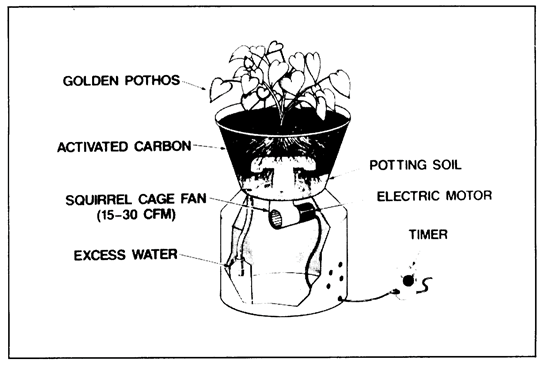
In conclusion the study found that low-light indoor plants in conjunction with carbon plants filters do display probabilities of improving air quality conditions for indoor. The numerous plants showed a decrease in the number of air pollutants removed from the enclosed glassed. The Mass cane was the plant that was shown to remove the highest level of formaldehyde from the environment, removing 70 percent of the air pollutants. [17] Gerber Daisy was the plant that proved to be most effective in removing Benzene at 67.7 percent reduction. [18] Pot Mum was the plant that reduced trichloroethylene by 41.2 percent. [19] The part of the plant that proved to be most effective in absorbing the toxins was the plant root soil zone. [20] The more air exposure the plant root soil area receives the more air filtration it will yield. [21] In addition, carbon filters should be used in homes to serve as a supplement when filtering larger volumes of air. [22]
With the large societal shift for more sustainable living and eco-friendly resources, it is important to note the power plants hold in providing natural air purifying qualities. Instead of spending hundreds of dollars a year on candles, air fresheners, and plug-in; it may be beneficial to invest in cultivating and maintaining indoor plants. Not only are they decorative accessories in the home, but they are also natural eco-friendly way towards cleaner air. Perhaps the next time you spot a local nursey, you consider taking home with you a Mass Cane or a Pot mum.
In more recent times, NASA continues its studies towards achieving cleaner air solutions. Their satellites remain the main avenue to track the levels of nitrogen dioxide, ground-level ozone, carbon monoxide, particulate matter (solid or liquid), sulfur dioxide, and lead in the United States and globally. [23] According to the Global Burden of Disease report, hazardous air pollutants continue to be the number one environmental cause of death. [24] The availability of air pollutant tracking satellites and the information gathered from NASA’s extensive studies continue to push for positive reforms in the public health sector and more sustainable ways to decrease air pollutants inside and outside the home. [25]
Written by Fabiola De Leon, EELJ Associate Editor
 Barry Law Environmental and Earth Law Journal
Leave a comment