What is your first thought when you hear the word vegan? Are you instantly repulsed or disgusted? Are you left wondering where they get their protein or if they miss your favorite meat filled products? Has anyone ever asked a meat eater who is questioning a vegan if they know their carbon footprint just by eating meat? Probably not.
First, if you do not know what a vegan is, veganism is a way of living which tries to exclude, as much and as practicable as possible, the usage and exploitation of animals. [1] Vegans eat a complete plant-based diet, which in today’s world is very easy. There is a plant-based meat alternative for any type of animal product or by-product you desire.
Second, if you do not know what a carbon footprint is, a carbon footprint is the total amount of greenhouses gases that are generated by your actions. [2] A person in the United states averages a carbon footprint of 16 tons; this is one of the highest rates in the world. Worldwide, the average is around four tons per person, however, to avoid a two-degree rise in global temperatures, people need to drop the average carbon footprint to under two tons by 2050.
Many people do not think about the carbon footprint that they are creating just by eating. Food production accounts for 25% of the world’s greenhouse gas emissions. [3] Around 14.5% of global greenhouse gas emissions are from the meat and dairy industry. According to a paper published in 2007, emissions from meat should be looked at in the same way as driving and flying. [4] Some estimate that animal agriculture is responsible for more greenhouse gases than all of the world’s transportation systems combined. [5] It was found that diets of daily meat-eaters generate 15.8 pounds of carbon-dioxide compared to a vegetarian which is 8.4 pounds of carbon-dioxide. Dietary greenhouse-gas emissions of meat eaters are at least 50% higher than vegetarians and at least 99% higher than vegans. According to a 2018 study, beef and lamb have the biggest carbon footprint, while non-animal products and by-products have a significantly lower carbon footprint. Emissions from plant-based foods are 10 to 50 times smaller than those from animal products. [6] See the graphs below from Carbonbrief.org which highlights the carbon footprints of food and the comparison of emissions based on diets:
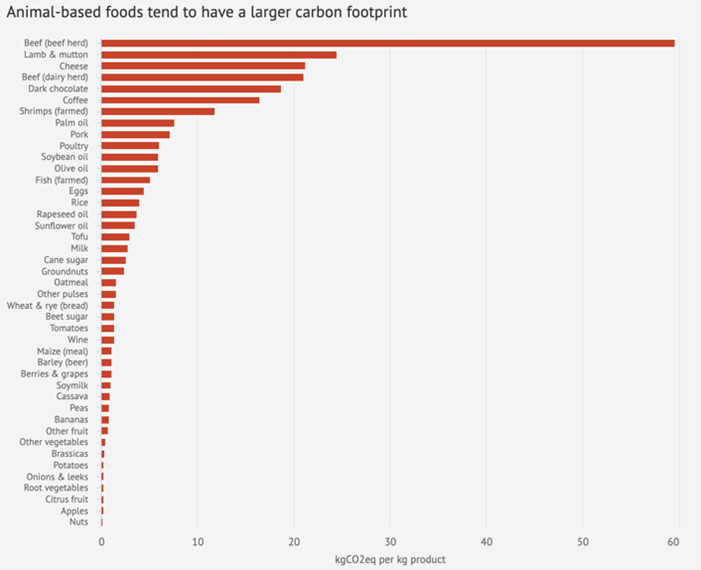
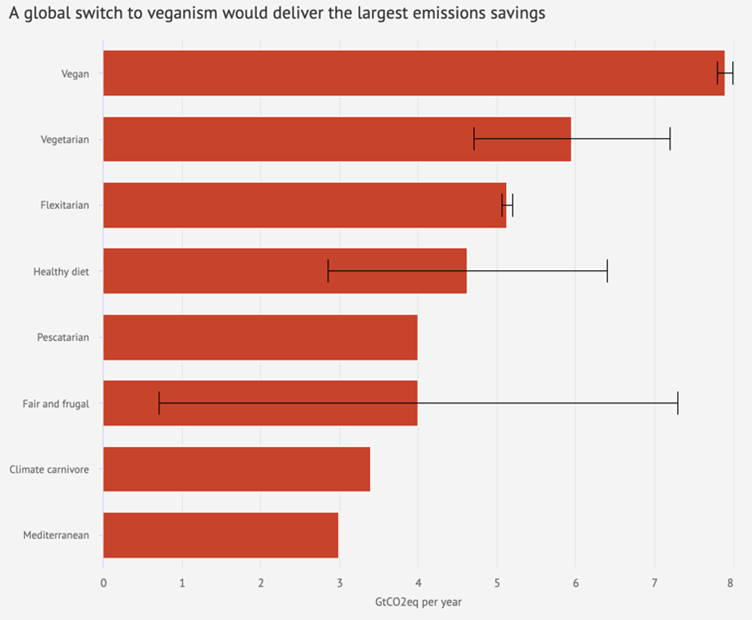
According to Carbonbrief.og, if people were to just change their diets to a healthier, less meat, more plant-based diet, carbon emissions would decline significantly by 2050. [7] In fact, if people were to alter their diets just slightly to consume less meat, the 2050 goal would be reached. Although it might be easy for someone in a developed and thriving country to make the change to plant-based, it is more challenging for those in low- and middle-income countries to make the change. Meat consumption in low- and middle-income countries has continued to rise. Many of these countries have traditional diets where consuming meat is seen as aspirational. [8] Additionally, beef has traditionally been seen as a staple for both the poor and rich as it is very inexpensive to produce and purchase. [9] Specific meats for both the rich and poor are seen as symbols of status; people purchase the meat for special occasions to celebrate. It would be challenging socially for people to change their diet; for example, it is very rare for someone to have a dinner party to show off their tofu.
One other pitfall to the idea of changing diets is that it is not a one-size-fits-all solution. Many nations are still developing and while, as of right now, they have low emissions, but when they grow, their emissions will also grow. In addition, the pandemic has disrupted the meat market and caused many facilities to shut down. Rather than it being a positive thing for there to be less meat available, it caused many animals to be killed for absolutely no reason and created the same, if not more, emissions.
Veganism and vegetarianism are not the end-all solutions to combat climate change, however it was a focus of the Paris Agreement in 2019. Rather than telling people what to eat, Dr. Hans-otto Pörtner came up with the idea for countries to create incentives for people to consume less food. [10] Unfortunately, it is not very common knowledge that a change in diet can help the fight against climate change and it is not very easy for a government to find a way to control someone’s diet. One suggestion proposed is to create a meat tax so that way plant-based food is less expensive. [11] There is no easy answer, however by making this public knowledge, people can choose to be more plant-based.
If you were told that you can help save the world from climate change by switching your diet, would you do it?
Written by Brittany Kurland, EELJ Associate Editor
 Barry Law Environmental and Earth Law Journal
Leave a comment