With the rising gas prices at the pump and the supply chain crisis, many Americans are worried about the cost of transportation and the availability of their favorite consumer goods; however, there is a resource more valuable than any consumer good and a liquid more important than gas. That resource is freshwater. The aquifers that reside under various states are one of the biggest supplies of fresh water in the United States, and the water supply of fresh water in the aquifers is dwindling. [1] [2]
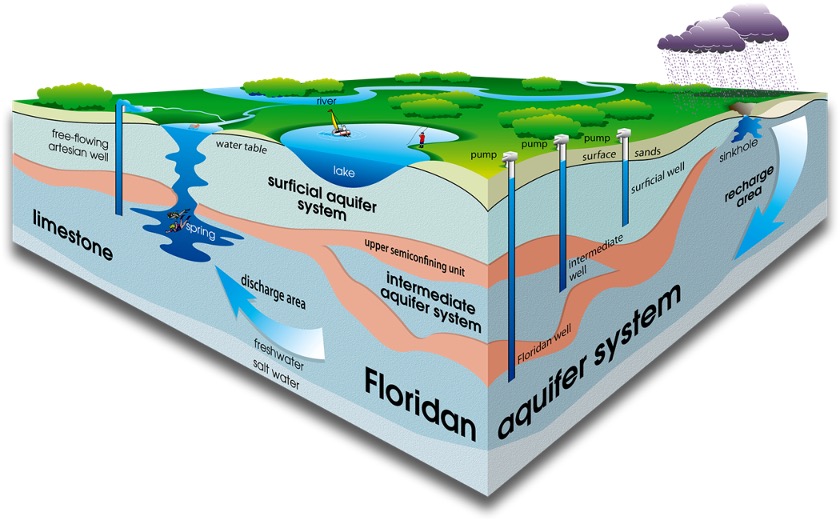
An aquifer is an underground bed of permeable rocks or porous sediment that allows water to filter through and gather. [3]Water usually enters aquifers through precipitation, and surface water seeps through the soil. [4] The process of moving through the soil, sediment, and bedrock act as a natural filter, removing contaminates, allowing water that would otherwise be contaminated or non-drinkable to become fresh drinkable water. [5] This pool of fresh groundwater is usually accessible through wells and springs. [6] [7]
Groundwater is vital to agriculture, as globally, nearly 70 percent of all freshwater is used for agriculture, and agriculture makes up 40 percent of the global food supply. [8] Groundwater makes up over 60 percent of livestock’s daily water intake. [9] Therefore, without a constant and consistent supply of groundwater from these aquifers, there would be global shortages in food. While a lack of groundwater from aquifers would undoubtedly have an indirect impact on peoples’ lives, Floridians would be impacted directly.
In Florida, most of the freshwater we use comes from groundwater in aquifers. [10] Local businesses, farms, and municipalities draw much of their water supplies from these aquifers. [11] “Supplying approximately 90 percent of the state’s drinking water, Florida’s aquifers supply more than 8 billion gallons of water each day; they are among the most productive in the world.” The Floridan Aquifer is located below Florida and encompasses parts of Alabama, Georgia, and South Carolina, and is the largest aquifer in the southeastern United States. [12] The Floridan Aquifer extends into the Gulf of Mexico and the Atlantic Ocean. [13] The Surficial Aquifer, which is also in Florida, is a widespread and shallow aquifer that “provide[s] most of the public freshwater supply southwest of Lake Okeechobee and along the Atlantic coast in St. Lucie, Martin, Palm Beach, Broward, and Miami-Dade counties.” [14] Aquifers are not just important in an abstract sense, they are essential for Floridians, and the depletion of these aquifers could be detrimental to our way of life.
Groundwater in these aquifers can become depleted if the water is pumped out at a faster rate than it can be replenished. [15] The water stored in these aquifers is replenished, or recharged, by rainfall and surface water. [16] The increased use of the water from aquifers is primarily due to the irrigation needed for expanding the agricultural landscape. [17]
Aquifers are being pumped too much, which is causing the aquifers to be depleted faster than they can be recharged. [18] This depletion eventually causes the aquifer to yield less and less water and eventually dry up. [19] On the issue of aquifer depletion, Robert Glennon, Regents’ Professor and Professor of Law and Public Policy at the University of Arizona, stated, “[t]he supplies is finite, but the access to it is not finite. It’s limitless.” [20] According to National Geographic, “Silver Springs, one of the Floridan aquifer’s largest springs, has seen its prodigious output fall from 500 million gallons [per day] to around 200 million gallons per day—an alarming 60 percent decline.” [21] Beyond the effects on agriculture, livestock, springs, and wells for Floridians, depleting aquifers can cause sinkholes and saltwater intrusion. [22]
This water crisis is not contained to just Florida. It is nationwide, engulfing states like California, Texas, and Arizona. [23]However, the battle is not lost. Many of the effects of aquifer depletion, like saltwater intrusion, can be mended or reversed. [24] A tripartite solution is needed that involves action from the government, action from corporations, business owners, and farmers, and action on a personal level. At the governmental level, the Department of Environmental Protection has proposed over 700 projects to conserve water around the state ranging from restoring wetlands to limiting water for individuals and businesses. [25] Farmers can use more efficient irrigation techniques like drip irrigation and nighttime irrigation to prevent water loss. [26] [27] Finally, individuals can water their lawns less, turn off the faucet while brushing their teeth, and use water-efficient dishwashers. [28] If we all work together, we can ensure that we, and subsequent generations, have access to the vital groundwater that these aquifers provide.
Written by Justin Allen, Note & Comment Editor 2022-2023
 Barry Law Environmental and Earth Law Journal
Leave a comment