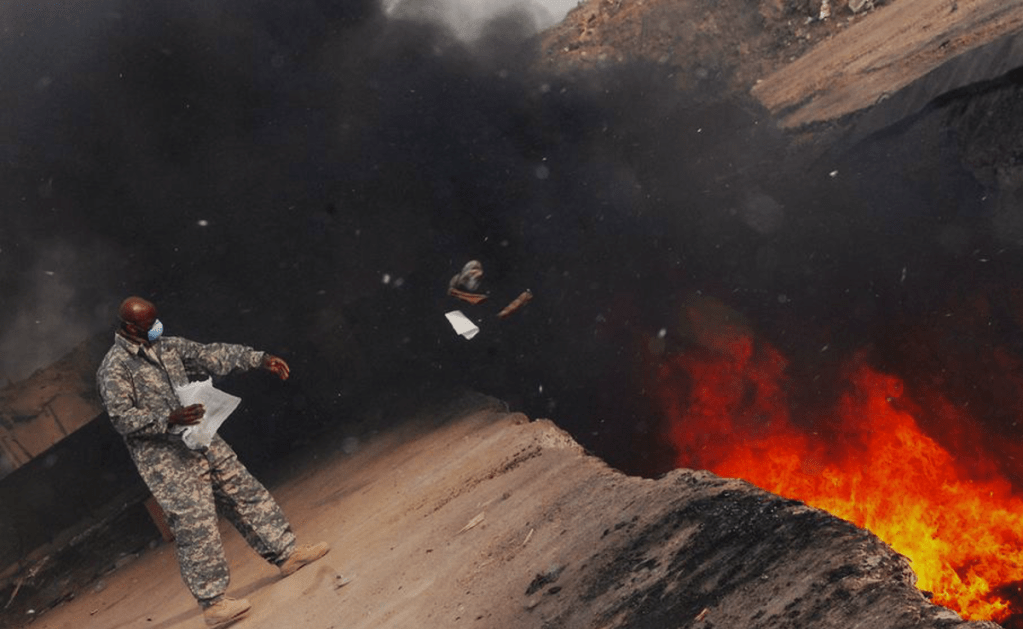
Open burn pits are standard military practice and have been used for years to dispose of waste and trash on military bases. On average, 100 to 200 tons of waste was burned every day at the Joint Base Balad in Iraq. [1] The men and women who served in Iraq and Afghanistan were exposed to burn pits at a higher rate; some attribute this more significant exposure to military contractor KBR, Inc.’s alleged negligence. [2] KBR (aka Kellogg) started supporting the logistics of the U.S. Military back in 1996. [3] KBR’s involvement with the U.S. military ranges from donating tanks to waste storage. [4] However, in 2009 KBR was hit with a lawsuit consisting of hundreds of veterans who claimed the open burn pits managed by KBR caused their health issues. [5] More specifically, they alleged KBR negligently placed the burn pits too close to the base and operated them without regard to wind speed and direction. [6] The law firm Motley Rice, LLC took on the case against KBR, but after a decade-long fight, the plaintiffs lost their case in 2019 when the United States Supreme Court refused to hear their appeal from the U.S. Court of Appeals 4th Circuit. [7]
Open-air burn pits are large areas of land used as a means of waste disposal on American bases. [8] The pits burned waste, such as plastics, medical waste, rubber, human feces, and urine. [9] While engulfed in flames, the pits released toxic fumes and harmful chemicals into the atmosphere. [10] Once burned, the substances emit smoke causing severe damage to the skin, lungs, heart, intestines, and nervous system. [11] The most severe substance released by burn pits is dioxin, a highly toxic pollutant. [12] Not surprisingly, people in the area developed severe health conditions from hazardous exposure. [13] The nonprofit organization, Iraq and Afghanistan Veterans of America, surveyed exposed veterans in 2020. The survey revealed eighty-six percent of post-9/11 veterans said they were exposed to burn pits while serving in Iraq or Afghanistan. [14]
Veterans suffering from toxic exposure aren’t anything new; the U.S. military used a harmful substance called Agent Orange during the Vietnam war. [15] Agent Orange was a mixture of herbicides used to destroy vegetation for operations. [16] By 1970 Agent Orange was no longer being produced, but its harmful effect is still present today. [17] Exposure to Agent Orange is linked to congenital disabilities, diabetes, cancer, and Parkinson’s disease. [18] Thousands of veterans exposed to Agent Orange are still waiting on medical help, as the VA has not added several diseased to the list of eligible diseases for Agent Orange. [19]
In response to the increasing demand for better benefits for exposed veterans, the Department of Veteran Affairs (“VA”) created the airborne hazards and open burn pit registry in 2014. [20] The registry collects data to help better understand the potential health effects of exposure to airborne hazards during military service. [21] The VA encourages veterans to participate in the survey, as their research is ongoing. While their intentions might be optimistic, the outcome so far has been subpar. [21] According to the deputy executive director of policy and procedures for the VA, Laurine Carson, between 2007 and 2020, the VA approved only 22 percent of disability claims related to burn-pit exposure, which translates to a 78% rejection rate. [22] This high rejections rate is because the previous veterans had the burden of proving their health issues were service-connected; there was no presumption that you were exposed if you served while next to an open burn pit. [23] Veterans had to document their illnesses to be compensated appropriately and covered medically. [24]
Recently this has changed, and now the VA agreed to believe specific disabilities are linked to burn pit exposure.[25] Finally, recognizing asthma, rhinitis, and sinusitis as automatically connected to veterans who served in specific areas at specific times. [26] Distinctively, veterans serving in Operation Freedom (OEF) and Operation Iraq Freedom (OIF). [27] On its face, this is a beautiful step forward after years of advocating for our veterans. Despite this, the VA has not granted presumptive status for those battling cancer, lung diseases, and kidney failure. [28] The men and women plagued with these diseases are typically young, and the VA denied the existence of acceptable evidence to link veterans’ claims to their burn pit exposure. [29]
Hope might not be lost; this past Veterans Day, the Biden administration announced a new policy would be established for U.S. veterans exposed to open burn pits. [30] The administration aims to help veterans receive benefits, specifically rare cancers, similar to Beau Biden’s death in 2015. [31] We are privileged to have heroes wearing dog tags protecting our freedoms. Some have given the ultimate sacrifice; their life. U.S. Veterans deserve more and need adequate compensation for their service. They deserve proper ongoing healthcare, resources, and support.
If you would like to help, check out this nonprofit organization committed to assisting Iraq and Afghanistan veterans by clicking here.
Written by Jessica Ocasio, Note & Comment Editor 2022-2023
 Barry Law Environmental and Earth Law Journal
Leave a comment