October 20, 2025
When people think of Florida’s coastline, they often picture rows of endless condominiums, resorts, and crystal-clear beaches. But hidden in that tropical paradise lies the hidden protector of the coastlines: Florida’s mangrove forests. These forests, often overshadowed by the loudness of development and tourism, are among Florida’s most important assets during hurricane season. In fact, along Florida’s Gulf and southern coasts, mangroves function as natural buffers to storms, protecting coastal or coastal-adjacent communities, property, and ecosystems. [1] The irony lies in the fact that as development grows, these natural barriers are often cleared or degraded, weakening the defense Florida coastlines rely on.
Why Florida’s Mangroves Matter for Hurricanes
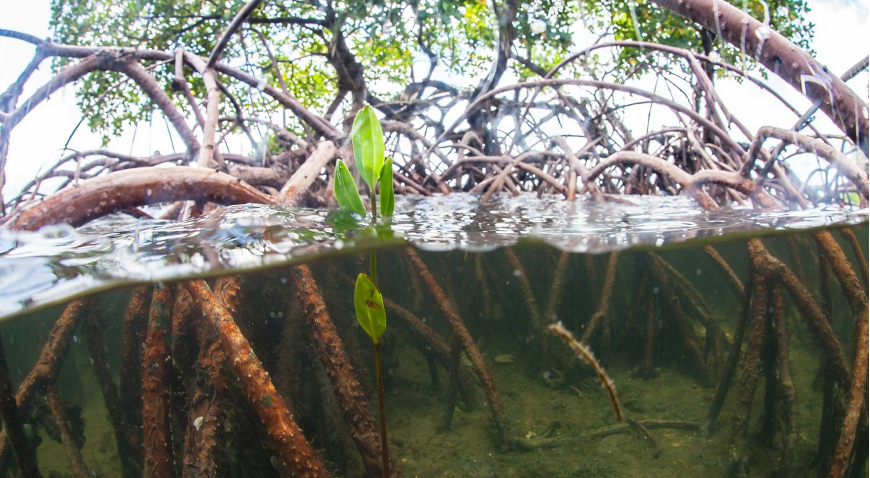
Mangroves are tropical plants that thrive on loose and wet soil, salt water, and partial root submersion. [2] What makes them especially useful during storms, however, is their unique structure: dense above- and below-ground roots, thick stands of trunks, and complex filter systems. [3] This unique structure of theirs helps slow down incoming water, absorbs wave and surge energy, and allows more of the surge to spread, be stored, or be filtered instead of crashing directly into homes. [4] According to the Florida Department of Environmental Protection (“DEP”), mangrove forests “protect uplands from storm winds, waves and floods,” and the amount of protection depends heavily on forest width. [5]
Many scientific studies back this statement up. According to a study found in the Environmental Law Alliance Worldwide, one model of a Florida mangrove zone estimated that surge amplitude declined by forty to fifty centimeters per kilometer (approximately fifteen to nineteen inches per mile) of mangrove forest width. [6] In other words, the wider the mangrove forest, the more surge height is reduced. For example, for a six- to thirty-kilometer (approximately three- to eighteen-miles) wide mangrove forest on Florida’s Gulf Coast, the flooding extent during Hurricane Wilma, a category three hurricane, was reduced by about 1,800 km2 (approximately 694 mi2) compared with what it would have been without the mangroves. [7]
Real-World Application
A study found that during Hurricane Irma in 2017, mangroves averted approximately $1.5 billion in flood damages and reduced losses by around twenty-five percent in the counties that were studied. [8] Another estimate from 2023 calculates that mangroves in Florida provide up to $7.6 billion annually in ecosystem service value for storm-loss reduction alone. [9]
Limitations of Mangrove Forests
Mangrove forests help a lot, but they won’t stop everything. These plants work best when they are wide, healthy, and continuous. Florida’s DEP makes this clear: a narrow mangrove fringe offers “limited protection,” while a wide stand can make a huge difference. [10]
According to a study found in the Environmental Law Alliance Worldwide, for a mangrove forest zone to significantly reduce storm surge from a hurricane of similar magnitude to Hurricane Wilma, it needed to be about seven to eight kilometers (approximately 4.3 to 4.9 miles) wide. [11] In other words, if development pushes mangroves to become narrow, fragmented, or degraded, their protective power significantly drops.
Why Development and Land-Use Choices Matter
Florida is seeing increasing development on its coasts: more homes, more resorts, and more infrastructure. This in turn pushes or even entirely removes the mangrove forests. [12] When these forests are replaced by seawalls, concrete, or simply are fully cleared, one of Florida’s most cost-effective methods of natural defense is weakened.
With increased migration and tourism in Florida, the pressure to build to accommodate often outpaces the pressure to preserve our lands. [13] If Florida loses mangrove cover for the sake of popularity, access, or development, the state is reducing the volume of the trees that could save billions in damages later.
Conclusion
Mangrove forests are an imperfect solution and do not eliminate hurricane dangers in Florida. But they are scientifically proven to be an economically valuable and ecologically powerful element of Florida’s coastal defense. Maintaining, restoring, and expanding mangrove forests in Florida is one of the cleanest, multi-benefit strategies available for reducing storm-related impacts on coastal communities. Protecting these trees is protecting Florida’s coastline, a win for its ecosystem and for its people.
Written by Andrea Aponte, Associate Editor 2025-2026.
 Barry Law Environmental and Earth Law Journal
Leave a comment